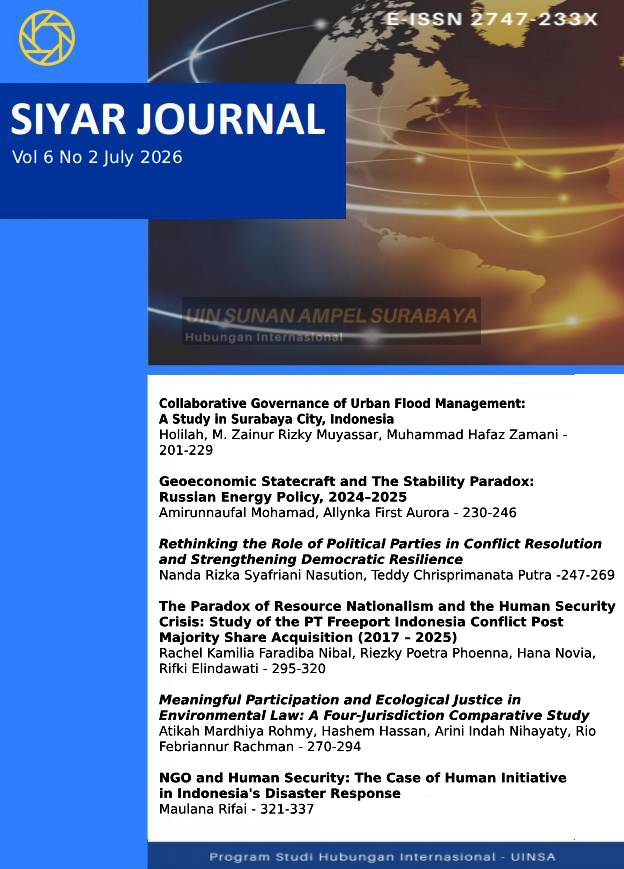
NGO and Human Security: The Case of Human Initiative in Indonesia's Disaster Response
DOI:
https://doi.org/10.15642/siyar.2026.6.2.321-337Keywords:
Non-Governmental Organization, Human Security, Human Initiative, Disaster ResponseAbstract
Indonesia is geographically located within the disaster-prone pacific ring of fire, making it vulnerable to recurring natural disasters such as floods, earthquakes, and landslides. These disasters pose significant threats to human survival and well-being. The presence of Non-Governmental Organizations (NGOs) becomes crucial in advocating, educating, and assisting disaster victims, completing the government's efforts in ensuring human security. The concept of human security is a non-traditional approach which relies heavily on human being or community rather than state entity. This study explores the role of Human Initiative in disaster management and the challenges it faces, with a focus on human security. David Lewis and Nazneen Kanji theoretical framework guides the analysis in this study. They identify three key roles that NGOs play: implementers, catalysts, and partners. This study adopts a qualitative method with a case study approach through field observations and interviews. The findings reveal that Human Initiative plays an active, responsive, and collaborative role in disaster management in Indonesia by addressing both individual and environmental security. Its achievement depends on a comprehensive and sustainable approach involving all stakeholders, including government entities, the private sector, and community organizations.Downloads
References
About Us [Human Initiative Profile]. Retrieved January 25, 2024, from: https://human-initiative.org/ tentang-kami/
Bakkur, D. et al. The Adaptive Governance of Natural Disaster Systems: Insights from the 2010 Mount Merapi Eruption in Indonesia. International Journal of Disaster Risk Reduction, Volume 13, (September 2015).
BNPB. Disaster Information Data in Indonesia. Retrieved January 19, 2024, from: https://dibi.bnpb.go.id/
Buzan, B.W. Security: A New Framework for Analysis. Jakarta: Lynner Rienner Publishers Inc, 1998
Cresswell, J.W. Research Design: Pendekatan Kualitatif, Kuantitatif dan Mixed. Edisi 4. Yogyakarta: Pustaka Pelajar, 2016
Fatah, A., Ulum, M., Bowo, T.A. Peran LSM dalam Penanggulangan Kekeringan dan Implikasinya Bagi Ketahanan Wilayah di Kapanewon Nglipar Gunungkidul, Provinsi Daerah Istimewa Yogyakarta (Studi Pada Yayasan Wahana Mandiri Indonesia). Jurnal Ketahanan Nasional, Vol. 29, No. 1, (April 2023)
Hadiwinata, B.S. Studi dan Teori Hubungan Internasional: Arus Utama, Alternatif, dan Reflektivis. Jakarta: Yayasan Pustaka Obor Indonesia, 2017.
Hidayah, E. The Role of Non-Government Organizations in Fulfilling the Right to Formal Education for Children of Overseas Refugees in DKI Jakarta Province. Journal of International Relations Studies. (2024). 3(1).
Kusuma, Linda, E, Kimura, K. (2008). Peran LSM Lokal dalam Manajemen Bencana: Studi Kasus LSM Lokal Indonesia dan Jepang. Tesis MPKD UGM
Lewis, D, Kanji, N. (2009). Non-Govertmental Organizations and Development. New York: Routledge
Luthfiyah. Research Methodology; Qualitative Research, Classroom Action and Case Studies. Sukabumi: CV Jejak, 2017.
Novianti, K. Peran NGOs Lingkungan dalam Mitigasi Banjir di Praha, Republik Ceko. Jurnal Kajian Wilayah, Vol. 4, No. 2, 2013.
Sibuea, Y.P. (2014). Implementation of Law No. 24 of 2007 on Flood Disaster Management. Leg Info. VI(02/II/P3DI).
UNDP. (1994). Human Development Report: New Dimensions of Human Security
Downloads
Published
How to Cite
Issue
Section
License
Copyright (c) 2026 Maulana Rifai

This work is licensed under a Creative Commons Attribution-ShareAlike 4.0 International License.