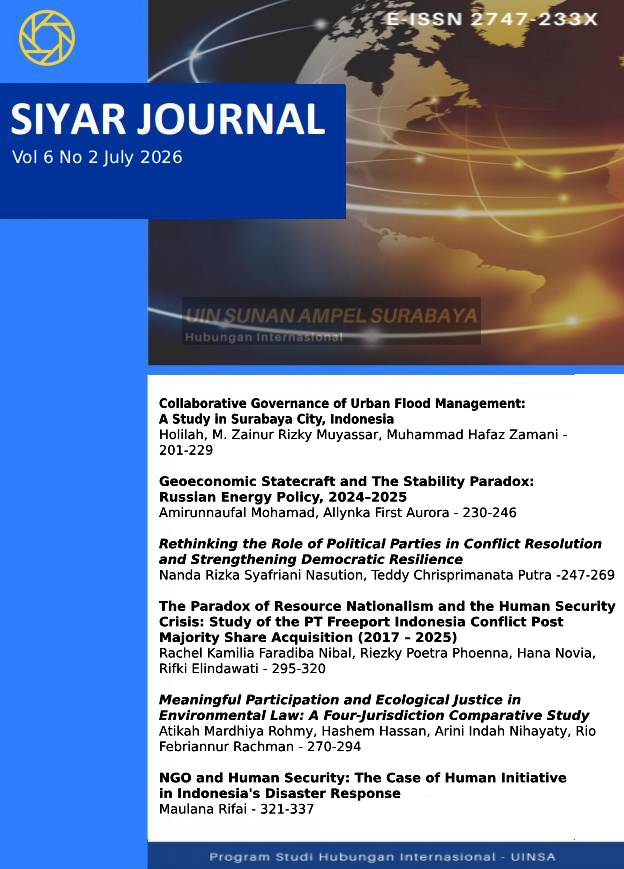
Collaborative Governance of Urban Flood Management: A Study in Surabaya City, Indonesia
DOI:
https://doi.org/10.15642/siyar.2026.6.2.201-229Keywords:
Collaborative governance, Urban flood management, Sustainable flood mitigation, Surabaya, IndonesiaAbstract
: Flooding remains a persistent challenge in rapidly urbanizing cities, including Surabaya, Indonesia. This study examines the application of democratic collaborative governance in urban flood management by analyzing how multi-stakeholder collaboration enhances sustainable flood mitigation. Guided by Ansell and Gash’s Collaborative Governance framework, the research investigates the interactions among local government, non-governmental organizations, the private sector, and local communities. A descriptive qualitative approach was employed through interviews, observations, and document analysis involving key stakeholders from the Surabaya Water Resources and Public Works Agency (DSDABM), the Regional Disaster Management Agency (BPBD), the Regional Representative Council (DPRD), and flood-affected residents. The findings indicate that Surabaya has strengthened flood governance through effective political leadership, institutional coordination, and participatory mechanisms such as the 112 Command Center and musrenbang (participatory development planning). These initiatives have improved emergency response, preparedness, and community engagement while supporting the localization of Sustainable Development Goals (SDGs), particularly SDG 11 (Sustainable Cities and Communities) and SDG 13 (Climate Action). However, challenges persist, including limited public awareness, technical constraints, extreme weather events, and socio-political barriers that reduce collaborative effectiveness. The study concludes that integrating democratic principles into collaborative governance enhances inclusiveness, accountability, and urban resilience, offering practical lessons for other cities seeking adaptive and sustainable approaches to flood management.Downloads
References
Ansell, C., & Gash, A. (2008). Collaborative Governance in Theory and Practice. Journal of Public Administration Research and Theory, 18(4), 543–571. https://doi.org/10.1093/jopart/mum032
Arvi, M. D., Sibarani, R. M. Y., Tanjung, Y. I., & Fairuz, T. (2025). Analisis Faktor Penyebab Bencana Banjir di Kota-Kota Besar Indonesia: Studi Kasus Analisis Banjir Berbasis Literasi. Indonesian Journal of Emerging Trends in Community Empowerment, 3(1), 1–8. https://doi.org/10.71383/ijetce.v3i1.70
Baldah, A., Duarisah, A. V., & Maulana, R. A. (2023). Clustering Daerah Rawan Bencana Alam Di Indonesia Berdasarkan Provinsi Dengan Metode K-Means. Vol. 14 No. 2, 31–36. https://doi.org/10.36982/jiig.v14i2.3186
Beni Setianto. (2025, February 13). Wawancara dengan Ketua RT 01 RW 03 Kelurahan Pakis, Kecamatan Sawahan [Personal communication].
BPS Surabaya. (2023). Kota Surabaya Dalam Angka 2023. https://surabayakota.bps.go.id/id/publication/2023/02/28/219438e973b16c7c80f11868/kota-surabaya-dalam-angka-2023.html
BPS Surabaya. (2024). Kota Surabaya Dalam Angka 2024. https://surabayakota.bps.go.id/id/publication/2024/02/28/38c76de6074beea6951be69e/kota-surabaya-dalam-angka-2024.html
Creswell, J. W., & Creswell, J. D. (2022). Research Design: Qualitative, Quantitative, and Mixed Methods Approaches. SAGE Publications.
Creswell, J. W., & Poth, C. N. (2017). Qualitative Inquiry and Research Design: Choosing Among Five Approaches. SAGE Publications.
Depary, F. G., & Manar, D. G. (2024). Politik Tata Kelola Bencana: Analisis Kepentingan Antar Aktor dalam Kasus Pengelolaan Bencana Banjir di Kota Medan Tahun 2023. Journal of Politic and Government Studies, 13(3), 713–726.
Dimas Mahardhika Akbar. (2025, February 12). Wawancara dengan Staff Bidang Drainase DSDABM Kota Surabaya [Personal communication].
Fakhrurrozi, M. (2024, April 5). Hujan Deras Selama 2 Jam, Sejumlah Kawasan di Surabaya Tergenang Banjir. https://portaljtv.com/news/hujan-deras-selama-2-jam-sejumlah-kawasan-di-surabaya-tergenang-banjir
Ghofar Ismail. (2025, February 18). Wawancara dengan Anggota DPRD Kota Surabaya [Personal communication].
Ginting, J. S., Irawan, B., & Daryono. (2022). Implementasi Kebijakan Antisipasi Dan Penanganan Banjir Kota Samarinda. Jurnal Administrative Reform, 10(1). https://doi.org/10.52239/jar.v10i1.7572
Hasna, A. L., & Darumurti, A. (2023). Collaborative Governance Dalam Mitigasi Bencana Banjir Rob Di Kota Pekalongan. JISIP UNJA (Jurnal Ilmu Sosial Ilmu Politik Universitas Jambi), 25–37. https://doi.org/10.22437/jisipunja.v7i1.24210
Jaka Triyanta. (2025, February 14). Wawancara dengan Masyarakat RT 3 RW 4 Kelurahan Simomulyo Baru, Kecamatan Sukomanunggal [Personal communication].
Joko Siswanto. (2025, February 28). Wawancara dengan Staff Penyuluh Bencana BPBD Kota Surabaya [Personal communication].
Miles, M. B., Huberman, A. M., & Saldana, J. (2014). Qualitative Data Analysis. SAGE.
Muhammad, F. I., & Aziz, Y. M. A. (2020). Implementasi Kebijakan Dalam Mitigasi Bencana Banjir Di Desa Dayeuhkolot. Kebijakan : Jurnal Ilmu Administrasi, 11(1), 52–61. https://doi.org/10.23969/kebijakan.v11i1.2235
Nasution, A. F. (2023). Metode Penelitian Kualitatif (Pertama). CV Harfa Creative.
Peraturan Walikota Surabaya. (2023). Peraturan Walikota Surabaya Nomor 20 Tahun 2023 Tentang Penyelenggaraan Command Center 112.
Perwali Kota Surabaya. (2021). Peraturan Walikota Surabaya Nomor 115 Tahun 2021 Tentang Penyelenggaraan Penanggulangan Bencana.
Rabsanjani, G. R., Akbar, A. A., & Herawati, H. (2022). Valuasi Dampak Banjir Di Kabupaten Landak, Kalimantan Barat. Volume 20 Issue 1 (2022), 65–75.
Rahayu, I. P., Rompas, W., & Dengo, S. (2021). Implementasi Kebijakan Penanggulangan Banjir Pemerintah Kota Manado (Studi Kasus Di Kecamatan Singkil). JURNAL ADMINISTRASI PUBLIK, 7(105). https://ejournal.unsrat.ac.id/v3/index.php/JAP/article/view/34862
Refnitasari, L., Cahyaka, H. W., Handayani, K. D., & Amudi, A. (2022). Analisis Kerentanan Fisik Wilayah Pesisir Utara Kota Surabaya Terhadap Bencana Banjir ROB. Vol. 14 No. 2 (2022): Jurnal Tata Kota dan Daerah, 55–62. https://doi.org/10.21776/ub.takoda.2022.014.02.2
Rosyidah, S. J., Putri, L., Sumarsono, A. P., Fadilah, S. R., & Nawangsari, E. R. (2024). Analisis Kebijakan Pemerintah Dalam Penanggulangan Bencana Banjir di Wilayah Pakal Surabaya Barat. JDKP Jurnal Desentralisasi Dan Kebijakan Publik, 5(1), 97–106. https://doi.org/10.30656/jdkp.v5i1.8784
Septian Hadinata. (2025, February 20). Wawancara dengan Masyarakat RT 4 RW 2 Kelurahan Sumberejo, Kecamatan Pakal [Personal communication].
Sugiyono. (2010). Metode Penelitian Kuantitatif Kualitatif dan R & D. Alfabeta,.
Tania Marwati. (2025, February 27). Wawancara dengan Masyarakat RT 7 RW 5 Kelurahan Ploso, Kecamatan Tambaksari [Personal communication].
UU No. 24 Tahun 2007. (2007). Database Peraturan | JDIH BPK. http://peraturan.bpk.go.id/Details/39901/uu-no-24-tahun-2007
Downloads
Published
How to Cite
Issue
Section
License
Copyright (c) 2026 Holilah Holilah, M. Zainur Rizky Muyassar, Muhammad Hafaz Zamani

This work is licensed under a Creative Commons Attribution-ShareAlike 4.0 International License.