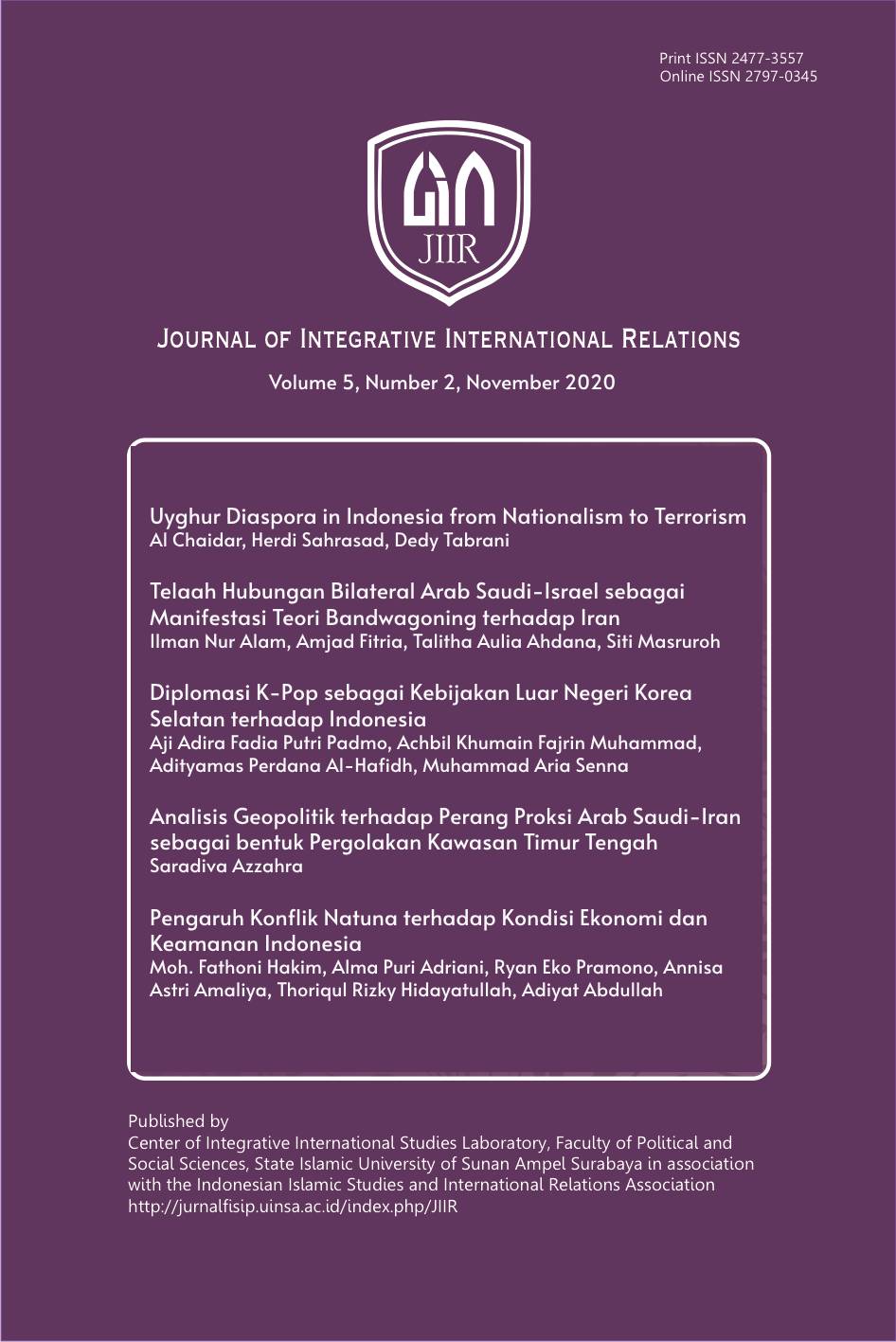
Uyghur Diaspora in Indonesia
from Nationalism to Terrorism
DOI:
https://doi.org/10.15642/jiir.2020.5.2.68-85Keywords:
Uyghur, China, Indonesia, Diaspora, TerrorismAbstract
Uyghurs, especially ethnic Turkestan originating from northwest China in Xinjiang province, have become a real part of jihad terror groups that are globally active. Uyghur jihadists first spread to various parts of the world when the United States and its allies attacked Afghanistan in 2001. While continuing their cooperation with the Taliban under the banner of the East Turkestan Islamic Movement (ETIM), Uyghur jihadists have now spread to Southeast Asia and the Middle East. ETIM members are part of the Turkestan Islamic Party fighting with the Al-Qaeda umbrella group in Syria, but other Uyghurs have joined ISIS in Syria and Iraq, and others have joined local terror groups in Indonesia. However, Uyghurs are currently under-examined as active participants in jihadist organizations. Their struggle against the Chinese Government or narrowly describes certain groups where Uyghurs have become participants. This paper explores the scope and scale of activities of foreign Uyghur fighters in various locations, their implications and how their participation in global jihad groups can develop in such a way.Downloads
References
Abuza, Zachary. The Uyghurs and China’s Regional Counter-Terrorism Efforts, https://jamestown.org/program/the-Uyghurs-and-chinas-regional-counter-terrorism-efforts/ accessed 11/1/2019.
Alatas, Alwi. Pergolakan Muslim Uyghur di Xinjiang dan Kebijakan Pemerintah China https://www.hidayatullah.com/kajian/sejarah/read/2018/12/31/157460/ pergolakan-muslim-Uyghur-di-xinjiang-dan-kebijakan-pemerintah-china.html
Al-Jazeera, 12 Desember 2014; al-Jazeera, 12 Maret; al-Jazeera, 1 April).
Al-Jazeera, 13 Maret 2016
Al-Jazeera, 24 Desember 2014 china.org.cn/english/MATERIAL/139230.htm
Anderson, Barbara A. & Silver, Brian D, ‘’Ethnic Differences in Fertility and Sex Ratios at Birth in China: Evidence from Xinjiang’’. Population Studies. Vol. 49, No. 2. Juli. 1995 pp. 211-226.
Becquelin, Nicolas. Xinjiang in the Nineties. The China Journal, No. 44, Juli 2000.
Boehm, Dana Carver. (2009). China’s Failed War on Terror: Fanning the Flames of Uyghur Separatist Violence, Berkeley Journal of Middle Eastern & Islamic
Law. Vol. 2. pp. 61-124.
Byler, Darren and Grose, Timothy China’s Surveillance Laboratory, Dissent, October 31, 2018.
Davis, Elizabeth Van Wie. Uyghur Muslim Ethnic Separatism in Xinjiang, China. Asia-Pacific Center for Security Studies, Januari 2008.
Freeberne, Michael, Demographic and Economic Changes in the Singkiang Uyghur Autonomous Region. Population Studies, Vol. 20, No. 1. Juli 1966, pp 103-124.
Haas, Benjamin. (2017). Howell, Anthony & Fan, C. Cindy. (2011). Migration and Inequality in Xinjiang: A Survey of Han and Uyghur Migrants in Urumqi. Eurasian Geography and Economics. Vol. 52, No. 1. pp. 119-139.
Ishfaq, Sarmad. The Sinicization and Suppression of China’s Muslim Uyghurs, Nov 23, 2018 https://www.foreignpolicyjournal.com/2018/11/23/the- sinicization-and-suppression-of-chinas-muslim-uyghurs/.
Kellner, Thierry. China: The Uyghur Situation from Independence for the Central Asian Republics to the Post 11 September Era. UNHCR Emergency & Security Service, WRITENET Paper No. 2/2002.
Morin, Adrien (Is China’s Counterterrorism Policy in Xinjiang Working? The Diplomat. February 23, 2017)
Mumford, Andrew. Theory-Testing Uyghur Terrorism in China Oktober 2018, Vol.2.
The Star, Malaysia, 4 Oktober 2014
Zhao, Tong. Social Cohesion and Islamic Radicalization: Implications from the Uyghur Insurgency. Journal of Strategic Security. Vol. 3, No. 3. 2010. pp. 39-52.
Downloads
Published
How to Cite
Issue
Section
License
Copyright (c) 2020 Journal of Integrative International Relations

This work is licensed under a Creative Commons Attribution 4.0 International License.