
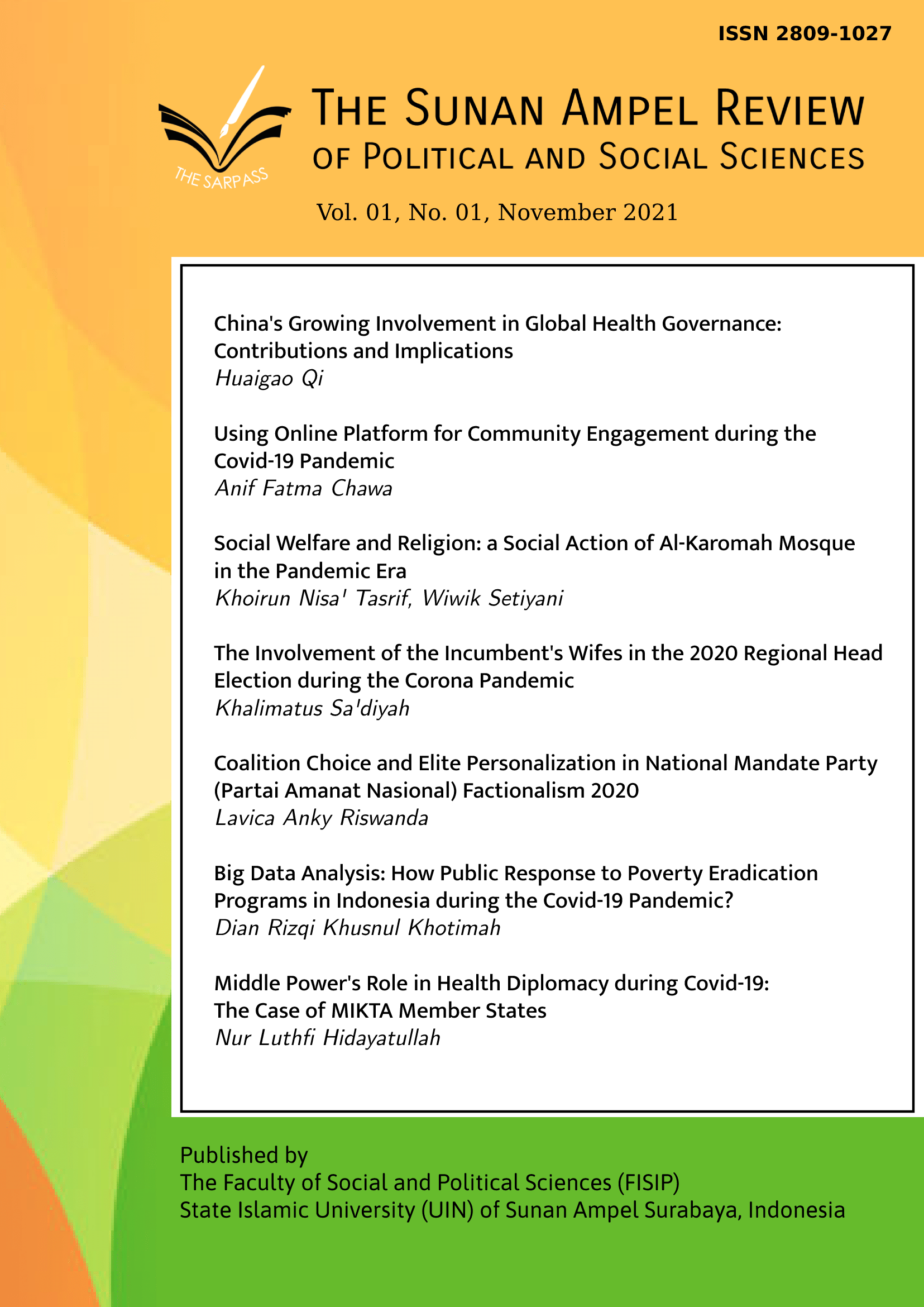
Middle Power’s Role in Health Diplomacy During Covid-19; The Case of Mikta Member States
Article Sidebar
Main Article Content
Abstract
Downloads
Article Details

This work is licensed under a Creative Commons Attribution-ShareAlike 4.0 International License.
References
Aksoy, H. A. (2020). Turkey and the Corona Crisis: The Instrumentalization of the Pandemic for Domestic and Foreign Policy. Geographical Overview. MPC’s Middle East and Turkey.
Australian Government. (2020). Indonesia Covid-19 Development Response Plan. Partnerships for Recovery: COVID-19 Development Response Plans 2020-21 and 2021-22.
Baldwin, D. (2013). Power and International Relations. In W. Carlsnaes (Ed.), Handbook of International Relations (pp. 291). Los Angeles: SAGE.
Bezglasnyy, A. (2013). Middle Power Theory Change and Continuity in the Asia Pacific. [Master Thesis, University of British Columbia].
Bland, B., Dayant, A., Edwards, J., Grenville, S., Kassam, N., Lemahieu, H., Leng, A., McGregor, R., McLeod, S., Oliver, A., Pryke, J., Rajah, R., Roggeven, S. & Scott, B. (2020). Emerging from COVID: Policy Responses to the Pandemic. Lowy Institute Policy Brief.
Chattu, V. K. (2014). Role of Global Health Diplomacy in enhancing Human Security: The growing inter-linkage between global health & foreign policy. The Graduate Institute Geneva.
Chattu, V. K. & Chami, G. (2020). “Global Health Diplomacy Amid the Covid-19 Pandemic: A Strategic Opportunity for Improving Health, Peace, and Well-Being in the CARICOM Region—A Systematic Review”. Social Sciences. Vol.9. No.88. 1-16.
Cho, C. (2012). “Illiberal Ends, Multilateral Means: Why Illiberal States Make Commitments to International Institutions”. Korean Journal of International Studies. Vol.10. No.2. 157-185.
Colakoglu, S. (2020). Turkey’s COVID-19 Diplomacy: International Cooperation in the Age of Global Health and Economic Crisis. KIEP Visiting Scholars Program.
Cooper, A. F. (2015). “MIKTA and the Global Projection of Middle Powers: Towards a Summit of Their Own?”. Global Summitry. Vol.1. No.1. 95-114.
Da-min, J. (2021). Korea Hosts MIKTA’s First Online Meeting Amid the Pandemic. The Korea Times. https://www.koreatimes.co.kr/www/nation/2021/06/120_301053.html
G7. (2021). What is the G7?. G7 United Kingdom 2021. https://www.g7uk.org/what-is-the-g7
Gauttam, P., Singh B. & Kaur, J. (2020). “Covid-19 and Chinese Global Health Diplomacy: Geopolitical Opportunity for China’s Hegemony?”. Millennial Asia. Vol.11. No.3. 318–340.
Gilley, B. (2012, September 10). The Rise of the Middle Powers. The New York Times. https://www.nytimes.com/2012/09/11/opinion/the-rise-of-the-middle-powers.html
Griffiths, M., O’Callaghan, T. & Roach, S. (2008). International Relations – Key Concepts: Second Edition. Oxon & New York: Routledge.
Gungor, B. (2021). Foreign Aid during the Covid-19 Pandemic. Evidence from Turkey, Southeast European and Black Sea Studies. https://doi.org/10.1080/14683857.2021.1900668
Guzzini, S. (2013). Power, Realism and Constructivism. London & New York: Routledge.
Hidayatullah, N. L. (2017). “Classifying Middle Powers based on Their Regional and Multilateral Roles: Differentiating Middle Power Enforcers, Assemblers, and Advocators”. Advances in Social Science, Education and Humanities Research (ASSEHR), Vol.143. 113-117.
Holbraad, C. (1984). Middle Powers in International Politics. London: Macmillan Press.
Hurrell, A. & Cooper, A. (2000). Paths to Power: Foreign Policy Strategies of Intermediate States. Latin American Program. Woodrow Wilson International Center for Scholars.
Islam, M. N. (2019). “BRICS, MIKTA, SCO and IBSA: Emerging Global Organizations and Groups: A Paradigm Shift for New World Order”. Adam Akademi. Vol.9. No.2. 471-490.
James, D. Garbutt, A. & Simister, N. (2017). Quasi-Experimental Approaches. Intrac for civil society. https://www.intrac.org/wpcms/wp-content/uploads/2017/01/Quasi-experimental-approaches.pdf
Jeong, E., Hagose, M., Jung, H., Ki, M. & Flahault, A. (2020). “Understanding South Korea’s Response to the COVID-19 Outbreak: A Real-Time Analysis”. International Journal of Environmental Research and Public Health.
Jordaan, E. (2003). “The Concept of a Middle Power in International Relations: distinguishing between traditional and emerging middle powers”. Politikon. Vol.30. No.2. 165-181.
Karadeniz, R. F. (2020). “The ‘Middle Power Moment’ Revisited in Global Governance: A Chance for MIKTA’s Legacy Crisis in Post-Pandemic World?”. Marmara University Journal of Political Science. Vol.8. 22-39.
Katz, R., Arnold, S., Lief, E. & Fischer, J. (2011). “Defining Health Diplomacy: Changing Demands in the Era of Globalization”. The Milbank Quarterly. Vol.89. No.3. 503-523.
Kemlu. (2021). Indonesian Minister of Foreign Affairs: MIKTA Countries Should Call for Equality of Vaccines for All. Ministry of Foreign Affairs of the Republic of Indonesia. https://kemlu.go.id/portal/en/read/2132/berita/indonesian-minister-of-foreign-affairs-mikta-countries-should-call-for-equality-of-vaccines-for-all
Kickbusch, I. & Erk, C. (2009). Global Health Diplomacy: The New Recognition of Health in Foreign Policy. In Clapham, A. & Robinson, M. (Ed.), Realizing the Right to Health (pp. 517-524). Zurich: Ruffer & Rub.
Kim, S., Haug, S., & Rimmer, S. (2018). “Minilateral Revisited: MIKTA as Slender Diplomacy in a Multiplex World”. Global Governance, Vol.24. 475-489.
Lee, S. H. (2014). Canada-Korea Middle Power Strategies: Historical Examples as Clues to Future Success. Asia Pacific Foundation of Canada.
Lee, S. H., Chun, C., Suh, H. & Thomsen, P. (2015). Middle Power in Action: The Evolving Nature of Diplomacy in the Age of Multilateralism. East Asia Institute. Seoul, South Korea.
Lee, S. T. & Kim, H. S. (2020). Nation branding in the Covid-19 era: South Korea’s pandemic public diplomacy. Place Branding and Public Diplomacy. https://doi.org/10.1057/s41254-020-00189-w
MIKTA. (2015). MIKTA Vision Statement. MIKTA: New Innovative Partnership. http://mikta.org/about/vision.php?ckattempt=1
MOFA. (2020). Five MIKTA Countries Adopt Foreign Ministers’ Joint Statement on Covid-19 Pandemic and Global Health. Ministry of Foreign Affairs, Republic of Korea. https://www.mofa.go.kr/eng/brd/m_5676/view.do?seq=321047
Neack, L. (2008). The New Foreign Policy: Power Seeking in a Globalized Era. Plymouth: Rowman & Littlefield.
Nye, J. (2008). Public Diplomacy and Soft Power. The ANNALS of the American Academy of Political and Social Science.
Pant, H. V. (2012). “Great Power Politics in East Asia: The US and China in Competition”. China Report. Vol.48. No.3. 237-251.
Rudolf, M. (2021). China’s Health Diplomacy during Covid-19: The Belt and Road Initiative (BRI) in Action. SWP Comment. German Institute for International and Security Affairs.
Sari, M. I. (2020). Implementation of Indonesia’s Defense Diplomacy in the Time of Covid-19 Pandemic. THC Insights, The Habibie Center. 21.
Scott, D. (2013). Australia as a Middle Power: Ambiguities of Role and Identity. Seton Hall Journal of Diplomacy and International Relations. 111-122.
Taneja, P. (2014). “Australian and Southeast Asian Perspective on China’s Military Modernization”. Journal of Asian Security and International Affairs. Vol.1. No.2. 145-162.
Tsygankov, A. (2010). “Russia’s Power and Alliances in the 21ST Century”. Politics. Vol.30. No.1. 43-51.
United Nations. (2020). Republic of Korea on Behalf of MIKTA Group. High-level Meeting to Commemorate the Seventy-fifth Anniversary of the United Nations. https://www.un.org/en/un75/commemoration/republic-korea
Valderrama, B., Islas, P., Tibaduiza, Y. & Soler, M. G. (2021). Vaccine Diplomacy and Political Diversification in Mexico’s Science and Technology Stakeholders. AAAS Center for Science and Diplomacy. https://www.sciencediplomacy.org/article/2021/vaccine-diplomacy-and-political-diversification-in-mexicos-science-and-technology
Wangke, H. (2021). “Indonesia’s Vaccine Diplomacy for the World Health”. Info Singkat, Research Center Expertise Agency of DPR RI. Vol.13. No.1.
Wasilewski, K. (2020). Turkey’s Corona Diplomacy: The Pandemic in Turkish Foreign Policy. The Polish Institute of International Relations. https://pism.pl/publications/Turkeys_Coronadiplomacy__The_Pandemic_in_Turkish_Foreign_Policy
World Health Organization. (2021). WHO Coronavirus (Covid-19) Dashboard. https://covid19.who.int/